
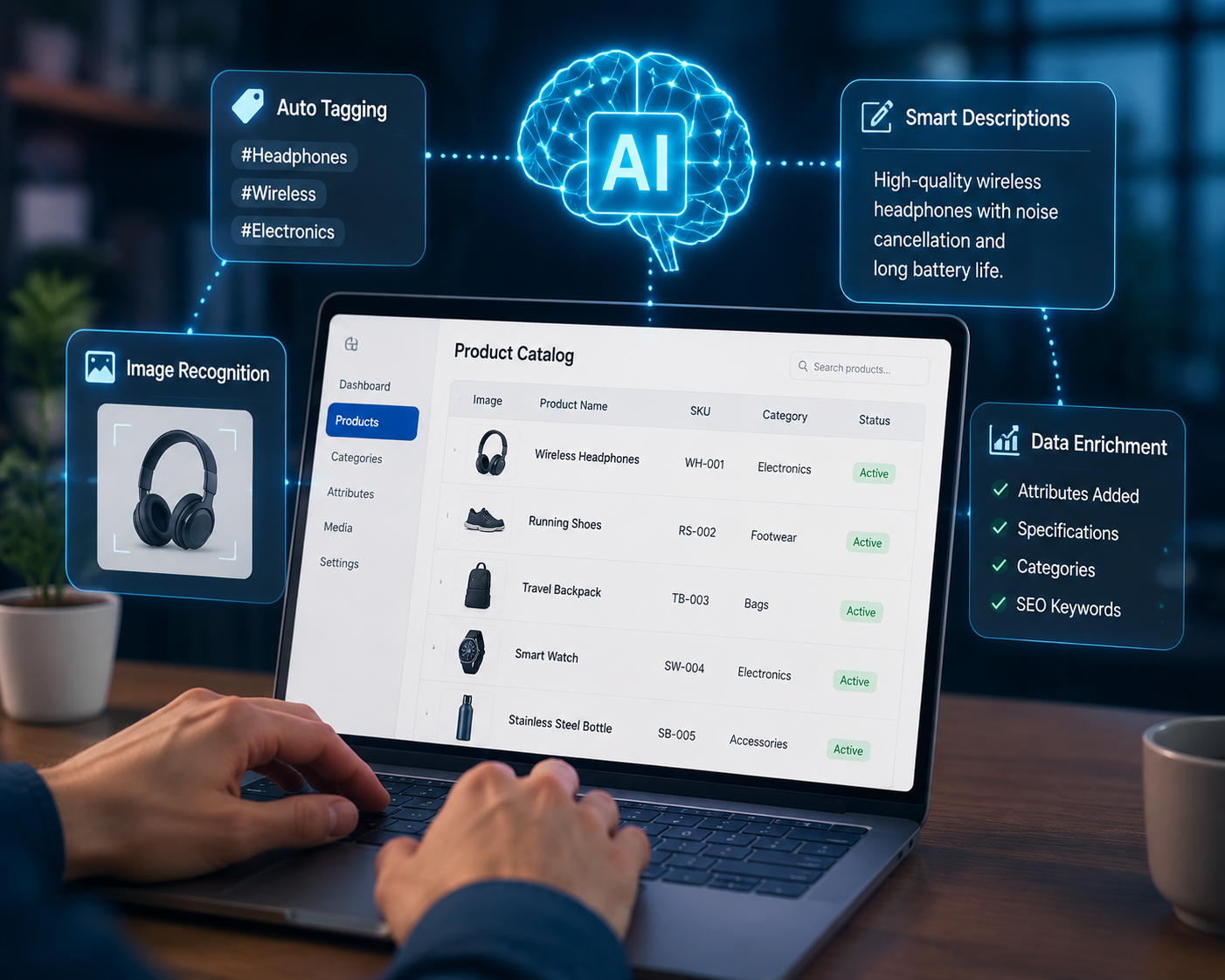
If you’re still working hours after hours to fix product data inaccuracies, update spreadsheets, remove duplicates, and rewrite product information for multiple sales channels, you’re not the only one. Creating eCommerce catalogs becomes complex and cumbersome to manage thousands or even millions of SKUs. Even minor inaccuracies in product information can negatively impact customer experiences, reduce visibility in search results, influence inaccurate product inventory, and prevent sales opportunities.
This is where AI makes a difference. AI is being used to automate repetitive catalog tasks, improve product data quality, accelerate catalog changes, and deliver more precise product experiences at scale. Businesses can now leverage intelligent systems to organize, enrich, maintain, and optimize product information more efficiently – rather than by relying on manual workflows.
This guide will help you learn how AI is playing a role in the day-to-day of catalog operations and its significance for businesses seeking to enhance their digital commerce strategies.
Many businesses start to experience catalog management problems because product information is provided by various suppliers, via spreadsheets, marketplaces, and within a company’s internal teams. Some of these products might be missing attributes, some might have duplicate records, and some might have a different title or category in different channels. By leveraging AI, this information can be connected, patterns recognized, data cleaned, and product information made more manageable at scale.
The Challenges of Traditional Catalog Management
Relying on manual supervision in traditional catalog management can be a significant operational constraint and barrier to business expansion. Manual product data entry is most prevalent. It’s inefficient, costly, and error-prone to copy and paste specs, type out dimensions, and upload image files one SKU at a time.
This human dependency naturally leads to inconsistencies in catalog information across channels. You might have “Waterproof Running Shoes” in your main store but “Men’s Outdoor Sneaker” in a partner store, which hurts your search index visibility and buyers’ understanding.
Manual vs AI-Powered Catalog Management Tools
| Catalog Task | Manual Catalog Management | AI-Powered Catalog Management |
|---|---|---|
| Products data entry | Teams spend time manually entering product data, leading to the risk of errors. | AI can extract, organize, and enrich product information from files, images, and supplier documents. |
| Duplicate detection | A lot of times, duplicate listings only appear when it results in confusion in the system. | AI can be used to analyze titles, attributes, images and metadata to detect similar or duplicate products more quickly. |
| Product categorization | Products need to be categorized manually, and this can become more challenging as catalogs grow in size. | AI can provide precise product category suggestions from product names, descriptions, attributes, and product images. |
| Product descriptions | Manual creation or editing of descriptions slows down the product launch. | AI can create clear, consistent, and SEO-savvy product descriptions on a large scale. |
| Channel updates | Product changes need to be communicated separately to different sales channels. | AI-enabled tools can aid in the consistency of product information across various platforms. |
| Catalog accuracy | There is a possibility for errors to go undetected until reported by a customer or when sales are impacted. | AI can identify missing information, values that are unusual, and product inconsistencies, ahead of time. |
It is evident from this comparison that AI is gaining significance in the world of business operations, especially when dealing with the complexities of large and intricate catalogs. AI is not just about faster work, it’s about more consistent work, less manual effort and a more reliable product data system.
Why AI Matters in Modern Catalog Management?
1. Automates Product Data Entry and Enrichment
Manual data entry is a bottleneck in catalog management, creating significant backlogs during new product launches. AI helps you with this problem by leveraging neural networks to identify certain measurements and materials mentioned in the supplier’s documents. With this automatic enrichment, you get your listings ready without typing a single thing, eliminating manual fatigue.
2. Improves Product Data Accuracy
Incorrect data can spoil all your efforts to create high-quality listings and cause you to lose customer trust. With intelligent solutions, you will avoid such problems because your listings are constantly checked for statistical anomalies, which is very important in how businesses manage data quality today.
3. Eliminates Duplicate Product Listings
Getting the same products from different suppliers usually overwhelms your backend database with duplicate stock codes. Using AI-based software, this can be sorted out by analyzing metadata and image patterns, allowing the computer to match duplicates at an incredibly fast pace.
4. Enhances Product Categorization
5. Generates High-Quality Product Descriptions
Generating new marketing content for the entire store takes ages and leaves you exhausted. This issue is resolved by generative language models, which convert technical specifications into engaging, branded descriptions at scale. Such an automated writing method eliminates the risk of search engine penalties for plagiarizing generic content provided by manufacturers.
This approach allows your store to stand out from others without losing a consistent brand tone. Marketing research shows that benefit-focused product descriptions tend to attract more consumer attention than basic feature-only descriptions.
6. Improves Catalog Search and Product Discovery
Keyword search boxes fall short of customers’ expectations since they only show results for exact matches. With semantic technology, this search process will be improved by recognizing what customers mean, even when they use conversational language, such as “weekend leisure clothes”.
7. Simplifies Multichannel Catalog Management
Each online marketplace has its own set of data requirements, pixel limitations, and requirements for what goes on the listing. Smart syndication tools make the task easier for you by automatically adjusting the master data in your catalog according to the requirements of external channels. This becomes even more important when managing product data across multiple sales channels through omnichannel retail systems.
8. Enables Real-Time Catalog Updates
Inventory processing in batches at the end of each day results in high-priced errors, such as showing customers out-of-stock items. An event-driven architecture solves this problem by ensuring that price changes and stock changes are broadcast to all storefronts immediately. This instantaneous updating ensures that your margins are maintained and that your orders are not costly mistakes.
9. Helps You Understand Your Catalog Better
10. Powers Personalized Product Experiences
Showing the exact same product page layout to every visitor limits your sales potential. Personalization tools alter what your catalog highlights based on individual browsing habits. If someone cares about eco-friendly parts, the system prioritizes sustainability tags; if they watch their budget, it emphasizes value metrics.
Personalized catalog experiences can improve customer engagement and support repeat purchases.
AI’s role in a Catalog Management workflow
AI is most effective when it is used to augment the complete catalog process, rather than a single task. The modern catalog process can start with Product Data Import, which can be done from supplier sheets, PDFs, images, or existing databases. AI can then clean the data, fill in missing attributes, identify duplicates, and categorize products.
Once the data has been cleaned, AI can assist in creating content, from enhancing product descriptions and tags to optimizing titles for search engines. When the catalog is in place, the same product data is then fine-tuned for each channel, ensuring that the teams are consistent on websites, marketplaces, and internal systems.
As time goes on, AI can also track the quality of catalogs, detecting outdated information, missing fields, duplicate listings, or even product details that require improvement. This translates to more proactive catalog management and for businesses, cleaner and more accurate product data as they grow.
If you want to get a comprehensive overview of the role of AI-powered systems in e-commerce growth, check out our article on AI-powered catalog management software for e-commerce.
Power the Future of Commerce with Kloudville Catalog Management
To scale across today’s digital channels, companies need to treat their product information as a primary asset, not just an internal activity. That’s when using cutting-edge catalog management software like Kloudville becomes especially important.
Kloudville platform incorporates enterprise-level AI into its Product Information Management (PIM) and Catalog systems. By consolidating your inventory policies, Kloudville will enable you to automate complex B2B and B2C multichannel listings, reduce your time-to-market, and remove the human element from your data entry, thereby protecting your margins.
FAQs
How does AI help catalog management tools?
AI helps catalog management tools by automating data entry, improving product accuracy, detecting duplicates, organizing categories, and keeping product information more consistent across channels.
Can AI improve product descriptions?
Yes. AI can use product attributes, specifications, and keywords to create clearer product descriptions that are easier for shoppers and search engines to understand.
Why is AI useful for large product catalogs?
AI is useful for large catalogs because it can process thousands of SKUs faster than manual teams, helping reduce errors, save time, and improve product data quality.
Can AI find duplicate product listings?
Yes. AI can compare product names, images, attributes, and metadata to identify duplicate or similar listings that may create confusion in the catalog.
Does AI replace catalog managers?
No. AI supports catalog managers by handling repetitive tasks, while human teams still review accuracy, strategy, brand tone, and final product information.