
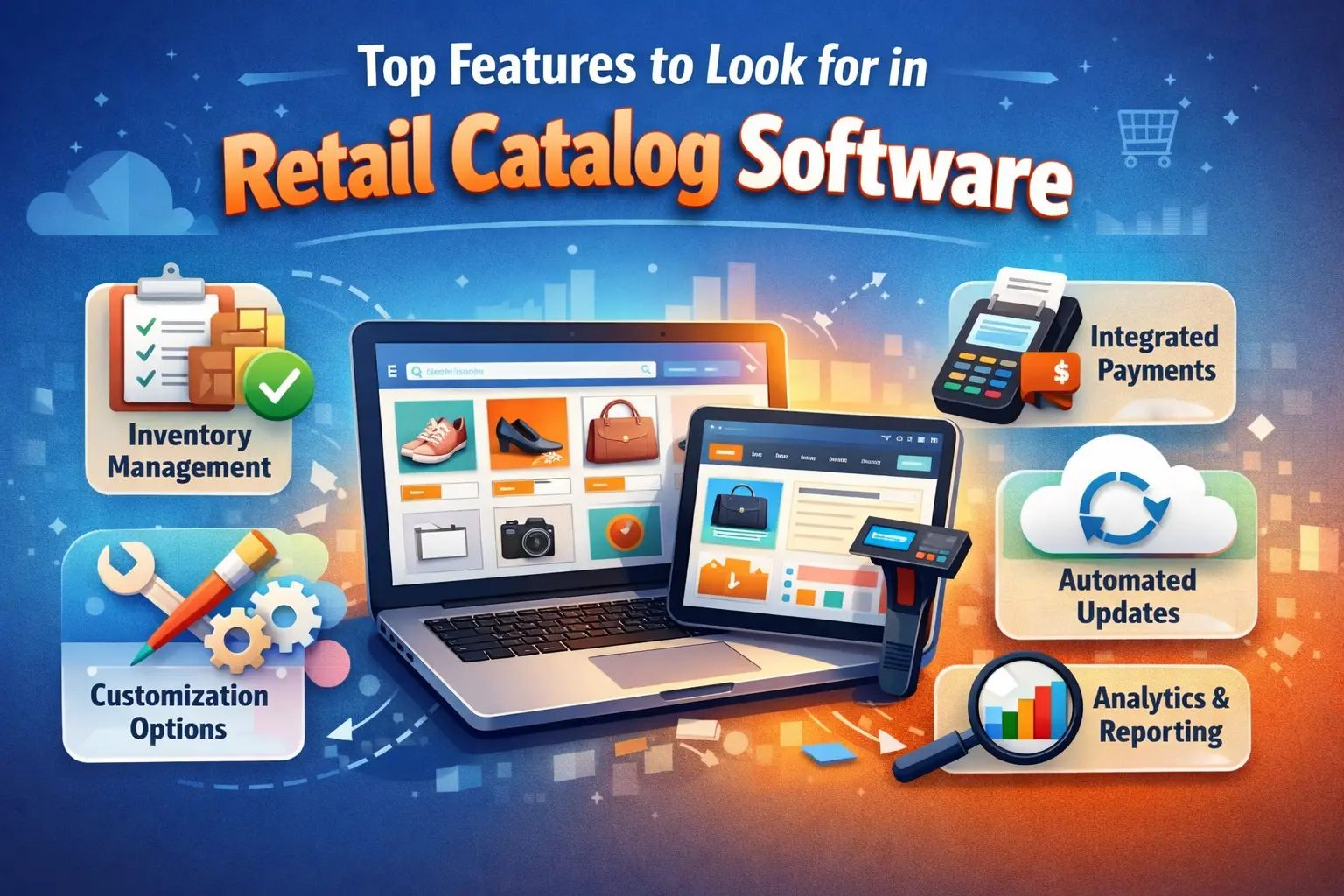
Without the use of an effective system, retailers end up using a spreadsheet approach or even manually updating their information. While this works perfectly for those with 50 products to manage, it gets extremely difficult to manage 5,000 or 50,000 products. To update the product description, one would thus have to repeat the same action in multiple places.
The trick is in making sure that the information is synchronized across all those different sources. These sources may be anything from the product description itself to the SKU number, pricing, pictures, and inventory data. By doing so, it becomes easier to update the information.
The retail business is growing very fast, and those that manage to stay relevant will be the ones that optimize their processes in the background.
Why Retailers Struggle Without Effective Retail Catalog Software
When product data lives in different places, confusion is inevitable this is where Retail Catalog Software becomes essential. Marketing teams may have one version of a product description, while sales teams rely on another. Inventory systems might show outdated stock levels, leading to overselling or missed opportunities.
This fragmentation creates what’s known as “data silos,” and they are one of the biggest productivity killers in retail. The amount of time spent on resolving inconsistencies far outweighs the actual time used to improve the business. This is similar to building a house when everyone is following a different plan.
Some of the obstacles may be:
- Duplicate product entries across platforms
- Inconsistent pricing and descriptions
- Delays in updating product information
- Increased risk of human error
All the above problems can be easily solved through centralization, where everything is centralized in one place. Everyone uses the same source of information, and all the modifications happen in real-time. Thus, there are fewer mistakes, better processes, and an effective workflow.
Digital Transformation and Its Influence on Product Management
There have been many changes in the retail sector over the past few years. While it was once simple, involving just managing inventory in stores and creating catalogs, it is now largely digitalized.
- Retailers now have to manage:
- E-commerce websites
- Mobile apps
- Online marketplaces
- Social commerce platforms
Every platform has unique demands and standards that must be adhered to. Attempting this by hand is not only impractical but almost impossible.
The rise of digital transformation has increased customer demands even further. They expect to receive instant notifications, accurate information about products, and quality images. Otherwise, they won’t think twice about moving on to another brand.
This shift has made advanced tools a necessity. These three aspects are no longer luxuries; they are necessities for surviving in today’s retail environment.
Product Information Management (PIM) in Centralized Catalog Management Software
In every well-oiled retail machine, there is a central product information management system. Here is where your product data resides, evolves, and gets distributed to other platforms.
Rather than managing several spreadsheets or using various tools to manage data, PIM serves as the central repository. This means that all your data, product titles and descriptions, pricing, SKU numbers, and attributes can be stored in one place.
Why is it so important? The answer is simple: consistent data builds trust.
Key advantages include:
- A single source of truth for all product data
- Reduced manual errors
- Improved team collaboration
- Faster product updates and launches
It becomes even more valuable as your business expands. Imagine organizing tens of thousands of SKUs without an effective system; it’s like having a library but no way to catalog its books.
Breaking Down Data Silos Among Various Departments
Data silos often create disputes among various departments. Marketing, sales, and stock control operate independently of each other, leading to conflicting data sets.
However, if everything is stored in one location, such problems become nonexistent. In this manner, everyone will have access to the same information and be aware of any updates made by other teams.
Single Source of Truth Creation
A single source of truth makes sure that there is only one true representation of your product data. It removes any confusion and helps reduce any discrepancies.
Customers viewing your product page on your website will see the same information as those who visit it through a marketplace.
Multi-Channel Distribution Capabilities
Single-platform selling simply does not work anymore. There are numerous customers everywhere, and their demands should be met. Multi-channel distribution provides a chance to distribute product information across several channels at once.
Manual updating of product information for each channel can be tiresome; therefore, an efficient system will enable automatic updating of the product information on all channels.
Advantages of multi-channel distribution include:
- Faster product launches across platforms
- Consistent product information
- Reduced manual workload
- Easier expansion into new channels
This capability is especially important for retailers looking to scale. It allows you to reach more customers without increasing operational complexity.
Marketplace & Platform Selling
There are different standards for each platform, and a good Retail Catalog Software ensures that your product data will automatically adapt to these standards.
This means that your platform will be able to format and map all product attributes and adhere to market standards. This is important for ensuring that the selling process runs smoothly.
Consistency Across All Channels
It is essential that all information provided about products across channels is consistent to gain consumer confidence.
Otherwise, consumers may be reluctant to buy the product.
Integration of Digital Asset Management (DAM)
Imagery is one of the most important factors that affect the decision to purchase a product. Images and videos can make customers choose either your product or another one available on the market.
Using DAM will help you efficiently manage all of your media files. Your team will be able to find the needed assets without wasting time on endless searches.
Features include:
- Storing images and videos
- Easy tagging and categorization
- Version control for updated assets
- Quick retrieval for faster workflows
- Managing Images, Videos, and Documents Efficiently
Managing digital assets manually becomes chaotic as your catalog grows. A DAM system simplifies this by organizing everything in a structured way.
It guarantees that the correct assets are always associated with the correct products.
Improving Customer Experience Using Rich Media

The customer depends on images. The clarity and video will assist the customer in comprehending the product and building trust.
Real-Time Inventory and Price Synchronization
Accurate information is key to retail success. It helps to synchronize the inventory and price details at all times.
Key advantages:
- Prevents overselling
- Maintains accurate pricing
- Improves customer trust
- Reduces manual updates
Preventing Overselling and Stock Errors
Overselling can harm your reputation and cause you operational problems. Real-time updates make sure that inventory is always correct.
Efficient Operations
Automating your business allows you to avoid updating things manually, freeing up your team to deal with more important matters.
Workflow Automation and Streamlining Processes
Manually doing things wastes time and can cause mistakes. Automating your workflow will help you do things faster and smarter.
Some examples of automation include:
- Product data enrichment
- Approval workflows
- Scheduled publishing
Product Data Enrichment Automation
The procedure ensures that all your product information is consistent and complete without human interference.
Time-to-Market Reduction
Speedy procedures equate to swift product introductions, allowing you to beat your competitors.
Flexible Data Modeling & Personalization
Every retail company has its own requirements, and yours should be personalized too. Flexible data modeling will give you this flexibility.
Advantages include:
- Custom attributes
- Easy handling of product variants
- Scalable structure
Supporting Complex Product Structures
Managing variations like size and color becomes much easier with flexible modeling.
Adapting to Retail-Specific Needs
Customization ensures that your system aligns with your business processes.
Data Validation and Quality Control
Maintaining accurate product data is critical. Data validation ensures that all information meets predefined standards before going live.
Key checks include:
- Required fields
- Format consistency
- Duplicate detection
Ensuring Accuracy Before Publishing
Validation tools catch errors early, ensuring that only accurate data reaches customers.
Reducing Costly Errors
Fewer errors mean fewer returns, complaints, and operational issues.
Advanced Search and Filtering Functionality
As your catalog grows, finding information quickly becomes essential. Advanced search features improve both internal efficiency and customer experience.
Internal Efficiency for Teams
Quick access to product data saves time and boosts productivity.
Enhancing Customer Navigation
Easy navigation helps customers find what they’re looking for faster, increasing conversions.
Integration, Scalability, and Global Capabilities in Catalog Management Software
A system should grow with your business. Integration and scalability ensure long-term success.
Important features:
- ERP and CRM integration
- Scalable infrastructure
- Multi-language support
- Role-based permissions
Connecting with ERP and Other Systems
Integration ensures seamless data flow across all business systems. Global capabilities allow you to expand into new markets without complications.
Conclusion
The selection of appropriate Catalog Management Software will completely revolutionize the way your retail store operates. Whether by consolidating data, offering multi-channel distribution capabilities, or automating processes, choosing appropriate features enables one to remain competitive amid growing competition.
The objective is not to manage but to optimize. Having your information available, consistent, and accurate means that you are on the path to success. Everything from your employees to your customer experience will be streamlined when your data is optimal.