
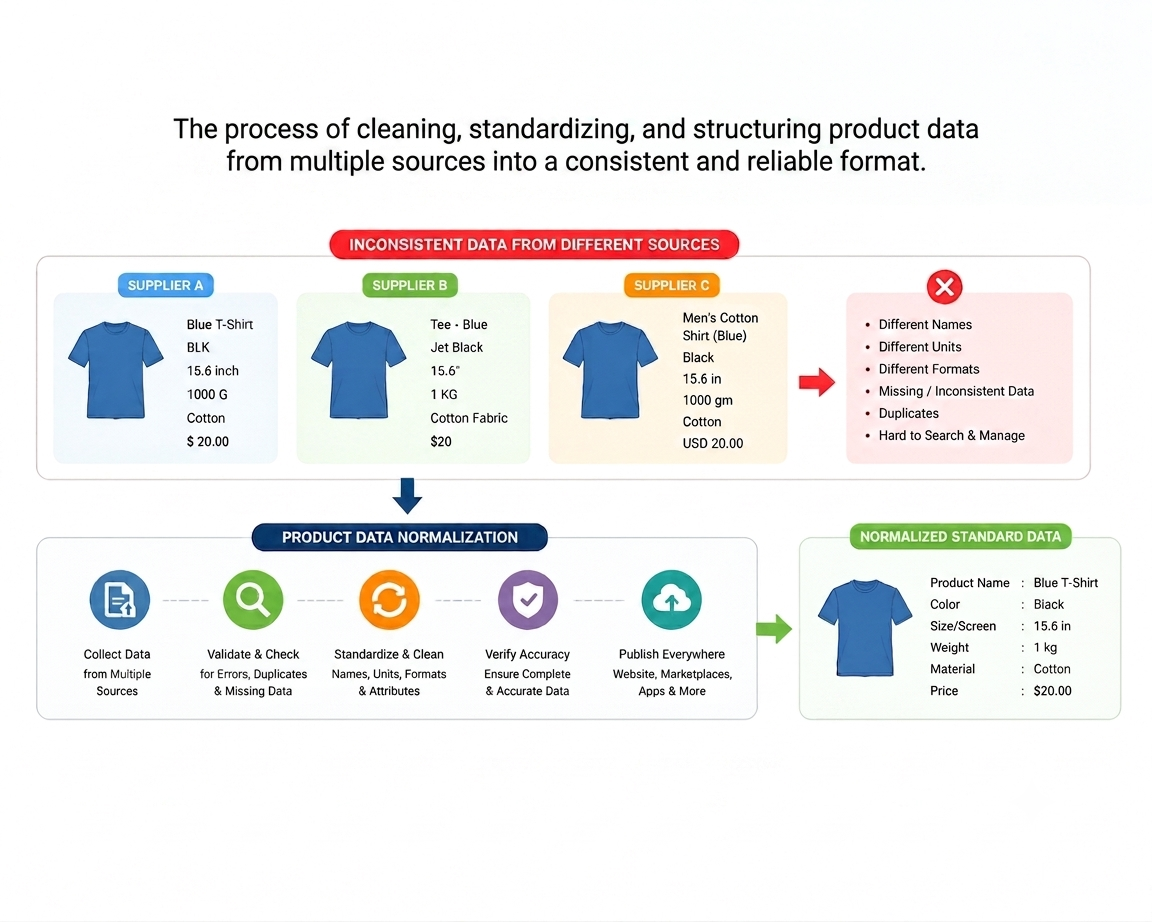
Managing product data sounds simple until your catalog starts growing. Some suppliers have a “Blue T-Shirt”, while others have a “Tee – Blue,” and a third have a “Men’s Cotton Shirt (Blue)”. Include various units of measure, missing product information, and duplicate products, and your product catalog soon becomes unmanageable.
Such inconsistencies may delay product releases, leave customers baffled, and lead to expensive mistakes throughout the sales process.
That’s where product data normalization in catalog management comes into play. It allows companies to organize their product information in a standardized format, helping businesses manage product catalogs online more efficiently and improving catalog management, search, updates, and scaling, as well as the shopping experience.
What is Product Data Normalization?
Product data normalization involves the process of structuring the data of a product from multiple sources into a single, well-structured data format. Normalization tidies up messy spelling, random capitalization, and various units of measure so that your database is as it should be.
It turns chaotic details into a single, reliable version of the truth for every item you sell.
When your business grows and you start managing thousands of products, keeping data clean is a huge necessity. If you import files from dozens of vendors, you take on all of their different typing habits. Without a clear step to normalize this text, your system gets bogged down by duplicate entries and confusing descriptions.
To see exactly how this works, look at how messy supplier files change after going through basic normalization:
| Product Detail | Supplier A (Raw File) | Supplier B (Raw File) | Normalized Standard |
| Screen Size | 15.6 inch | 15.6″ | 15.6 in |
| Color | Blk | Jet Black | Black |
| Brand Name | HEWLETT-PACKARD | HP | HP |
How Product Data Normalization Works?
Moving from messy spreadsheets to a clean, live website follows a simple, logical process. Following these steps helps your team save time and keeps your store running smoothly.
- Gathering the Data: The system is designed to collect all the raw files, spreadsheets, and images sent by all of your various suppliers.
- Checking for Errors: The system checks the files for typos, duplicate items, broken text, and blank spaces that could affect your website’s search capabilities.
- Fixing the Formats: Corrects miscapitalized words, standardizes product titles, and converts all measurements to a uniform format.
- Checking accuracy: Before going live, the clean data is automatically subject to checking to ensure that key data, such as price, size, and barcodes, are accurate.
- Getting the Products: The complete and consistent information about your products is directly published to your website and online marketplaces.
Why Product Data Normalization Matters in Catalog Management?
Keeping your product details clean and uniform does more than just organize your digital files. With the help of catalog management software, businesses can maintain accurate product information, reduce errors, protect their profits, and keep their customers happy.
When your data is neat, your website’s search bars and filters work perfectly. A shopper looking for a “Black” laptop will see every single option available, instead of missing items because a vendor typed “Blk.” This smooth experience prevents frustration, builds customer trust, and stops people from leaving your site to shop somewhere else.
Behind the scenes, accurate data prevents costly mistakes. Warehouse teams can ship orders faster because there are no duplicate listings or confusing descriptions to figure out. Your management team can look at clear sales reports to make smart purchasing decisions, instead of wasting hours trying to fix broken spreadsheets.
Common Product Data Problems That Normalization Solves
Without clear rules, an online store’s database naturally fills up with errors over time. These issues hurt your search engine rankings and cause confusion for your team. Common catalog management problems include:
1) Inconsistent Names
Suppliers often use completely different titles for the exact same item. One might write Brand Laptop Pro while another types Pro Laptop 15 inch. This confuses your computer system and your customers. Normalization rewrites all these titles so they follow one clear style across your entire store.
2) Accidental Duplicates
When you import products from multiple vendors, the same item can get added to your store multiple times under slightly different names. This creates messy double listings on your website. Normalization catches these identical items and merges them into a single clean page so shoppers do not get confused.
3) Measurement Confusion
Vendors use all sorts of different short forms for sizes and weights. You will often see a mix of inches, centimeters, pounds, and kilograms typed in random ways, like in or inches. Normalization automatically converts all these variations into one single measurement standard that makes sense to everyone.
4) Blank Information Fields
Important technical details are frequently left completely blank in raw supplier files. When details like color or material are missing, your website sidebar filters stop working correctly. Normalization scans your files to find these empty spaces so your team can fill them in before the product goes live.
5) Messy Text Formatting
Raw data sheets from vendors usually arrive with a lot of messy typos. You will often see broken symbols, accidental punctuation mistakes, and sloppy capitalization, like all capital letters. A reliable catalog system helps automate data cleaning and validation, which reduces human error while ensuring product descriptions remain clean, professional, and easy for customers to read.
Benefits of Product Data Normalization
Using clean data structures gives your online store immediate advantages.
- Quick Search: Customers will be able to find exactly what they need through the correct use of filters on the website.
- Professional Listing: Your products will appear to be professional and well-organized regardless of whether people shop from a computer, mobile application, or Amazon.
- Adding New Items Within a Few Hours: You will be able to list new products from suppliers within a few hours rather than within days or even weeks.
- Saving on Operations Costs: People won’t need to spend much time correcting mistakes, so they will be able to focus on the development of the business.
- Accurate Business Analysis: The right information means correct calculations of sales and profits.
Best Practices for Product Data Normalization
To keep your digital catalog healthy for the long term, your team should practice a few good habits.
First, create a single guide that shows exactly how every product title and category must be written. Use set dropdown menus instead of letting staff type whatever they want into info boxes. Pick one standard unit of measurement for your store and set up automatic rules to convert any different units into that standard.
Next, you need to make sure you verify and sanitize any supplier information before it comes into contact with your live store database. Perform frequent “mini-audits” to identify any double entries and formatting mistakes that may occur.
Trends Around Product Data Normalization
These are the leading trends in today’s product data organization and cleaning for online stores:
Smart AI Assistants: Smart AI can instantly scan messy lists, rather than rules, being written by people. It decipherably determines the implication of data, for instance, “crimson” and “ruby” are both words for “Red”.
Instant Updates: Systems now clean data as it is imported, rather than a slow update at night. This way, your website and business numbers are accurate from the get-go.
All-in-One Software Tools: Data-cleaning tools are no longer one thing, done on one spreadsheet. They are integrated straight into the core inventory systems, such as PIM and Master Data Management.
Connected Networks: Advanced data structures, such as data fabrics and data meshes, are employed to link various data sources, forming connected networks in modern businesses. Automated cleaning gives you a consistent and coherent appearance throughout the network.
ERP Integration: Catalog systems are integrated with ERP platforms to synchronize product data, inventory, and business information, improving accuracy and reducing manual updates.
Conclusion: Simplify Product Data Normalization with Catalog Software
Manually cleaning and sorting thousands of moving product rows is simply too time-consuming with simple spreadsheets. It drains your team, leads to constant typos, and slows down your new item launch.
A dedicated Catalog Management software, such as Kloudville, revolutionizes your workflow. The software serves as an automated central point linking chaotic supplier files with your real site. It removes all formatting issues, combines all duplicate listings, and completes missing information according to your rules.
The platform will make these repetitive tasks automated, and thus your store wouldn’t need a large data entry staff to expand from thousands of products to a million. It ensures the accuracy of your store, the cleanliness of your database, and the smooth scaling of your operations.
FAQs:
1. What problems does product data normalization solve?
Product data normalization solves common catalog issues such as duplicate products, inconsistent product names, incorrect measurements, missing details, and formatting errors by creating standardized product information.
2. How does product data normalization improve an online store?
Product data normalization improves an online store by making products easier to search, filter, and compare. It helps customers find accurate information and creates a better shopping experience.
3. What is an example of product data normalization?
An example of product data normalization is changing different supplier entries like “Blk,” “Black Color,” and “Jet Black” into one standard value: “Black.”
4. Can product data normalization be automated?
Yes, product data normalization can be automated using catalog management software, AI tools, and data management systems that clean, standardize, and validate product information.
5. How is product data normalization different from product data cleaning?
Product data cleaning focuses on fixing errors such as typos, missing fields, and incorrect values, while product data normalization goes further by organizing information into a consistent structure and format across the entire catalog.